
Key takeaways
- Western Digital’s helium drives reduce power consumption by over 35% (10.9W to 7W)
- WD’s modern 32TB helium drives achieve 0.3W/TB vs 2.85W/TB for older 4TB traditional air drives
- Data centers are prioritizing storage efficiency as the cloud’s global power consumption grows
- W/TB optimization translates directly to lower TCO, reducing electricity costs and infrastructure investment
- Energy-efficient HDDs enable reinvestment in AI, analytics, and innovation
Data centers are hungry for energy
The phenomenal rise of the cloud has been a boon to businesses and consumers alike—but with that tremendous growth has come a steep increase in energy consumption. Nor is the global outlook getting any rosier. By the end of this decade, data centers in the U.S. alone are projected to consume more than 10% of the nation’s electricity, up from roughly 4% today1—a considerably bigger piece of a bigger energy pie.
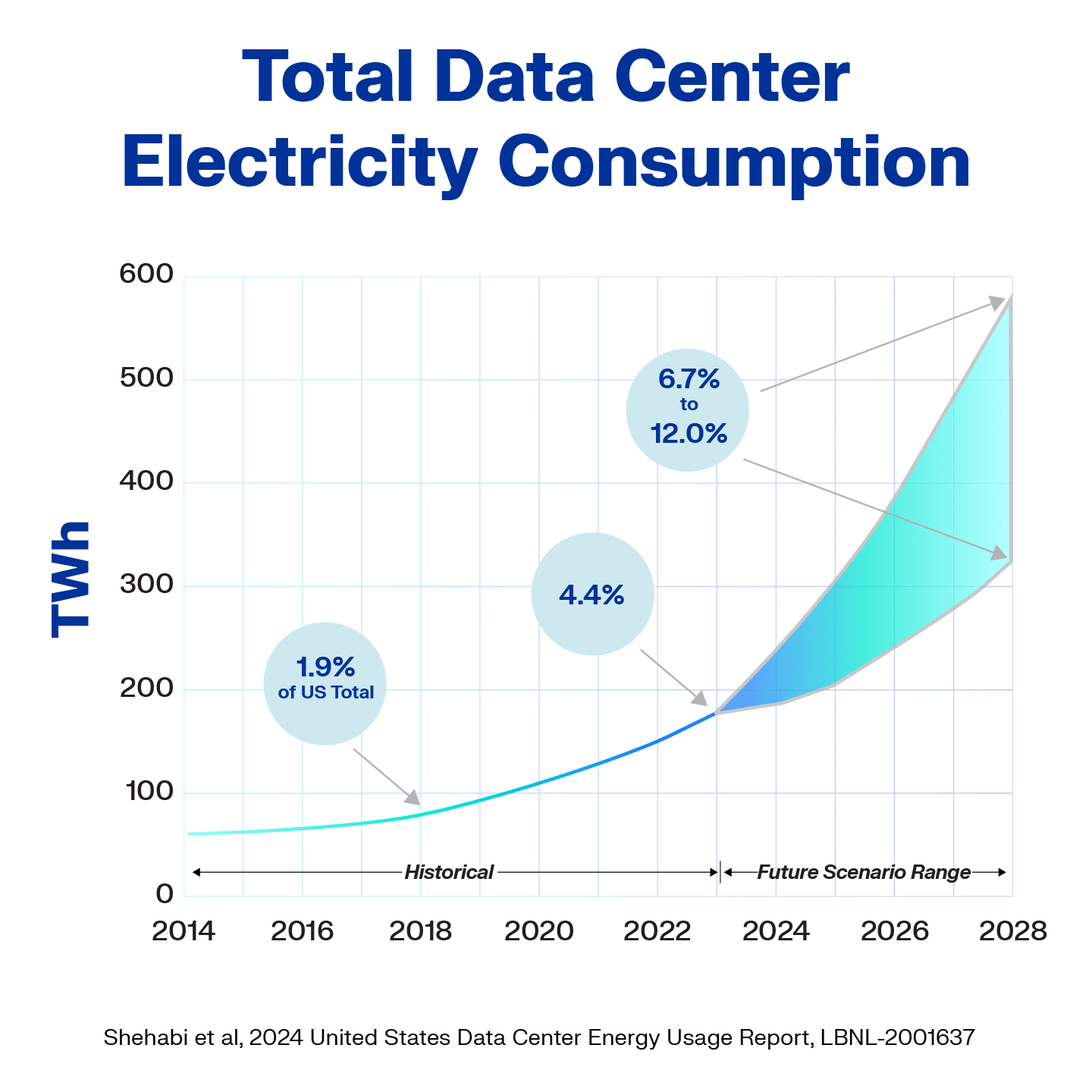
But the electricity bill is just one part of the picture. When factoring energy into their total cost of ownership (TCO), data centers have to consider what James Hamilton of AWS called “the fully burdened cost of power”2: the money spent on electricity itself along with the amortized cost of the infrastructure to deliver, condition, and cool that energy. As early as the mid-2010s, power and cooling infrastructure ate up about 80% of a new data center’s construction budget, with only 20% of costs going toward land, steel, and construction.3
Cloud migration saw early efficiency gains
Migrating enterprise workloads to the cloud often helped improve efficiency. Cloud data centers operate at much higher utilization levels than traditional enterprise IT, and companies have been able to spread energy costs across far more compute and storage cycles.
Microsoft, for example, reported that their cloud services are “up to 93 percent more energy-efficient than a traditional enterprise data center.”4 But now, with the majority of workloads already migrated, growth in cloud services translates directly into net new growth in energy consumption.
Engineering HDDs for a smaller energy footprint
The rise of large-scale AI is making the energy situation even more complex. Training and deploying large transformer models require unprecedented amounts of computing power, networking, and storage.5 Meeting this challenge requires rethinking every component of data center infrastructure—including hard drives, the backbone of cloud storage.
The energy footprint of an HDD is shaped by fundamental physics. Inside a traditional air-filled drive, spinning platters create high-speed airflow that works as friction (aerodynamic drag) to the spinning disk. As a result, the power consumption of the spindle motor increases.
Also, the high-speed airflow becomes turbulent (unsteady flow), which causes mechanical vibration of the internal components of an HDD, resulting in degraded position accuracy between the read/write head and the data-track on the disk. This effect limits the data-track density (capacity) of the HDD.
Improving HDD efficiency with helium
To tackle this problem, Western Digital pioneered helium-filled HDDs. Helium is just 1/7 the density of air, and the lower resistance inside the drive reduces aerodynamic drag. It also significantly reduces the turbulence. The result:
- A reduction in HDD power consumption of over 35%, from ~10.9W to ~7W.6
- Lower turbulence allows thinner platters, which means more disks can be stacked within the same 3.5-inch form factor. This has led directly to our development of the world’s first 11-disk HDDs.
- Increased track density improves capacity without proportional increases in energy draw.
As significant as these results were, they tell just part of the story—because the helium drive was more than just a standalone breakthrough.
Watts per terabyte tell the story
The development of helium drive technology was not merely innovation for innovation’s sake. It was borne out of Western Digital’s recognition of core issues facing data centers—power consumption and heat generation—and our desire to do our part to address those problems.
The effort, then, represents a fundamental change in direction: designing HDDs with energy efficiency as a first-order principle, aligned with the cloud era’s most pressing needs.
The metric that captures Western Digital’s efforts in increasing drive efficiency is watts per terabyte (W/TB). While an older 4TB traditional air drive consumes about 2.85W/TB, WD’s modern 32TB helium drive only consumes right around 0.3W/TB—an over 9x improvement that translates directly to lower TCO.7
Power innovation roadmap
With generative AI workloads creating relentless pressure for storage efficiency, HDD innovation is entering its next chapter. At Western Digital, we’ve built our success on being technology agnostic, not limiting our R&D to a single potential solution.
We’re taking the same approach to the efficiency-at-scale dilemma by doubling down on our efforts in this area and actively exploring a number of different pathways, including conducting extensive research on advance materials and mechanics that we believe will lead to even more game-changing improvements in energy consumption, capacity scaling, and W/TB ratios.
Clearing the energy bottleneck
These advancements will be crucial because with AI and the cloud continuing to turbocharge the world’s economic engines, access to ample energy threatens to stand in the way of sustained growth. As cloud operators weigh new data center builds, energy supplies are now as important as capital budgets.
By driving down HDDs’ power requirements, we’re expanding the capacity of global data infrastructure without proportionally increasing electricity demand. But optimizing watts per terabyte is no longer just about cost savings and reducing energy use—it’s how the most data-intensive companies will scale responsibly, unlock capacity, and reinvest in innovation. In this way, efficiency has become the new growth engine.
HDD innovation drives growth
The ability to store more data per watt means greater data throughput within fixed power envelopes. Seen this way, HDD efficiency gains do more than just help clear the energy bottleneck, they become a direct accelerator of business capacity and innovation, freeing up capital to reinvest in AI, data analytics, and customer R&D.
So, it’s no exaggeration to say that optimizing watts per terabyte is all about driving ultimate business value.
A new wave of innovation
HDDs remain the most cost-effective, readily accessible medium at scale for storing massive datasets, from archival backups to training data for generative AI. But Western Digital is not done innovating. The same spirit of exploration that led us to create helium drives a decade ago is propelling our next wave of breakthroughs. We’re working hard to develop the next game-changing tools that will ensure the cloud—and the AI revolution it powers—remains both economically viable and environmentally sustainable. The needs are clear, and we’re ready for the challenge.
- Shehabi et al, 2024 United States Data Center Energy Usage Report, LBNL-2001637.
- https://perspectives.mvdirona.com/2008/11/cost-of-power-in-large-scale-data-centers/
- Barroso, Clidaras & Hölzle, “The Datacenter as a Computer: An Introduction to the Design of Warehouse-Scale Machines,” Second Edition, p. 92.
- https://datacenters.microsoft.com/globe/powering-sustainable-transformation/
- Cottier et al., The rising costs of training frontier AI models, arXiv:2405.21015, 2025.
- https://documents.westerndigital.com/content/dam/doc-library/en_us/assets/public/western-digital/product/data-center-drives/ultrastar-sata-series/data-sheet-ultrastar-7k4000.pdf; https://documents.westerndigital.com/content/dam/doc-library/en_us/assets/public/western-digital/product/data-center-drives/ultrastar-sas-series/data-sheet-ultrastar-he6.pdf; https://www.westerndigital.com/content/dam/doc-library/en_us/assets/public/western-digital/product/data-center-drives/ultrastar-dc-hc500-series/data-sheet-ultrastar-dc-hc590.pdf; https://www.westerndigital.com/content/dam/doc-library/en_us/assets/public/western-digital/product/data-center-drives/ultrastar-dc-hc600-series/data-sheet-ultrastar-dc-hc690.pdf
- https://documents.westerndigital.com/content/dam/doc-library/en_us/assets/public/western-digital/product/data-center-drives/ultrastar-sata-series/data-sheet-ultrastar-7k4000.pdf; https://documents.westerndigital.com/content/dam/doc-library/en_us/assets/public/western-digital/product/data-center-drives/ultrastar-sas-series/data-sheet-ultrastar-he6.pdf; https://www.westerndigital.com/content/dam/doc-library/en_us/assets/public/western-digital/product/data-center-drives/ultrastar-dc-ha300-series/data-sheet-ultrastar-dc-ha340.pdf